Low, Medium, or High EC: How to Choose a Feed Strength for Your Cannabis Room
Two flower rooms. Same genetics, same coco, same lights. One runs a feed EC of 2.2; the other runs 3.0. That higher EC can mean more fertilizer in every gallon. But the real question isn’t necessarily which number is right. It’s whether anyone working in the second room can explain why they’re feeding at 3.0.
In practice, feed EC is often inherited from the last chart, the last run, a forum thread, or whatever program is taped to the fertigation room wall. It’s a decision that can stick around for a long time without anyone revisiting the reasoning behind it.
When the program works, it’s easy to leave it alone. When it doesn’t, you need to understand what to adjust and why. Feed strength is a dial growers can control directly, and turning it up has a real cost in fertilizer. The research offers useful guidance on where to set it and when more may not mean better. More on that below.

Three ECs, one meter
People often talk about EC as if it’s one measurement, but it can be measured at three different points. Before choosing a feed strength, you need to know which one you’re talking about.
Feed EC is the solution strength at the dripper. It is the number on a feed chart and the only one the grower sets directly.
Substrate EC is the concentration in the pore water around the roots. It runs higher than feed EC, because plants pull water out of the root zone faster than they pull salts. This is the measurement a sensor placed in the medium reports.
Runoff EC is measured in the water that drains from the bottom of the container after irrigation. It gives growers a practical estimate of substrate EC, using just a cup and a meter.
The confusion is not academic. Some widely circulated root-zone targets recommend running 4 to 10 EC in flower. Those are substrate readings, but a grower who reads them as feed targets and mixes to 6.0 has tripled the fertilizer going into the room for nothing. Everything that follows is about feed EC.
What the feed strength tiers actually represent
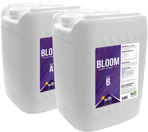
Rx Green’s dry fertilizer feed chart is published as a basic guideline, and is built to support three different feed strengths. All three run the same three products, Part A, Part B and PK. What changes is the concentration.
| Tier | Peak veg EC | Peak flower EC |
|---|---|---|
| Low | 1.9 | 2.3 |
| Medium | 2.2 | 2.7 |
| High | 2.9 | 3.5 |
The medium chart is Rx Green’s recommended feed strength for ideal EC levels. It carries clones at 1.1, ramps veg from 2.0 to 2.2, holds early flower at 2.4, peaks at 2.7 for flower weeks 3 through 6, steps back down to 2.4, and finishes at 1.3. Each tier comes as a simple version, one setting for veg and one for flower, or as a week-by-week schedule. Rx Green’s product team recommends the simple version in the large majority of rooms.
For a more finely tuned dial, the same feed chart page carries a mixing chart outlining grams per gallon of each part for any target EC from 0.5 to 3.0 in veg and 2.0 to 5.0 in flower.
Two notes included with the chart should not be overlooked: one, runoff should be measured weekly and sit within 20% of the feed. And, two, the source water EC should be subtracted from the target before mixing; a 2.4 target in 0.4 EC tap water is a 2.0 feed plus 0.4 of whatever the municipality added, which is why a source water analysis should come first.

What feeding harder buys, according to the research
Until recently, the case for running any particular EC was experience, habit, and lore. There are now controlled trials every grower needs to be aware of, and they agree with each other.
- In 2025, Bruce Bugbee’s lab at Utah State University grew high-CBD cannabis through a 56-day flower at a feed EC of 2.0 and again at 4.0. The conclusion: “Doubling the nutrient solution concentration from an EC of 2 to 4 mS per cm had no effect on flower yield or cannabinoid concentration.” (Hershkowitz, Westmoreland and Bugbee, Frontiers in Plant Science, 2025)
- The same paper cites a 2023 trial in Acta Horticulturae that found no yield difference between 1.8 and 3.0 EC. Pushing to 12 EC cut yield three-fold.
- A 2025 stone wool trial ran flower at 4.0 and 8.0 EC to see whether osmotic stress could shorten plants. It did, by 15%. It also cost one of two cultivars about 20% of its yield, with no change in total cannabinoids. (Allred, Fatzinger and Bugbee, Journal of Cannabis Research, 2025)
- A 2023 flowering trial fed nitrogen at 80, 160 and 240 mg/L. The middle rate delivered 95% of the CBD yield of the high rate on one-third less fertilizer. (Massuela et al., Frontiers in Plant Science, 2023)
While none of the trials ran coco drain-to-waste, the pattern across four independent trials is hard to argue with. Above roughly 2.0 EC, extra strength has not produced extra yield or cannabinoids in any published test, and at the top of the range it costs yield. The burden of proof sits with the higher number. We’re sure there are growers out there that have seen results otherwise, but if you’re running high EC consistently, it’s worth doing some side-by-side tests to see if any costs can be saved on nutrients by running lower concentrations.
What the extra strength costs
A 2.0 EC flower feed is 7.66 grams of product per gallon across the three parts. A 3.0 feed is 11.7 grams. That is 53% more fertilizer in every gallon that leaves the tank, which is significant.
Fertilizer is not the only line that scales with EC. So does the salt load the substrate carries between irrigations, the runoff needed to keep it from accumulating, and the nutrients that flush in that runoff. Coco holds cations on its exchange sites and releases them slowly, which is part of why it forgives so much, and why salt that goes in at 3.0 is not lost on the first heavy irrigation.
Valid reasons to increase EC
A room earns the high EC feed chart under a short list of conditions:
Light intensity. Higher PPFD drives more photosynthesis and transpiration, and the demand for water and nutrients rises with it. This is the one reason that holds almost everywhere it is claimed.
CO2 enrichment. CO2 raises the ceiling on photosynthesis, and the plant needs the inputs to use it.
Irrigation frequency and dryback. Many small irrigations a day keep substrate EC close to feed EC. One or two large irrigations with deep drybacks concentrate salts between events, and the same feed lands harder at the root.
Monitoring. Substrate sensors and daily runoff logs show EC creep the day it starts. A Friday runoff check does not. The high chart is for rooms that can closely monitor what it is doing.
Cultivar demand. Some particular genetics show hunger on the medium chart under high light. That is a reason to step up, not a reason to start there.
The reverse list gets less attention. Rooms should step down when source water carries EC of its own, when runoff volume is low, and when nobody is measuring. Coco, buffered and stable, is not a reason to feed harder. It is a reason a room can afford to feed lighter and stay consistent.
One program, many cultivars
The strongest objection to a single feed strength is genetics, and that is partly right. A 2026 uptake study on two commercial varieties measured early-veg nitrogen and potassium uptake running meaningfully higher in one than the other. The stone wool trial referenced earlier saw one cultivar lose yield at 8 EC while the other held. Cultivars differ.
The answer is not a different recipe for every strain; it is the same recipe at a different strength. Høst Cannabis has run more than 40 active strains in Denver on one Rx Green dry fertilizer program for over two years. General Manager Tyler Carr put it plainly: “Consistency is everything when you’re running 40+ strains, and Rx Green delivers that consistency every time.” Once the EC was dialed in, the team reports, the program runs predictably, and runoff pH confirms the coco is buffering as it should.
That is what the feed strength tiers and the mixing chart are for. A room adjusts strength to the plant in front of it, not the formula. Three parts. One program. Every strain.

The runoff test: how to confirm the feed tier in two weeks
A grower does not necessarily need an expensive sensor array to know whether the strength is right. The chart’s own rule is enough: runoff within 20% of feed, checked weekly.
- Start on the tier below where instinct says. Medium for most rooms. Low for rooms running lower light, infrequent irrigation, or unmeasured water.
- Collect runoff from the same three or four plants each time, at the same point in the day. Measure feed at the dripper and runoff in the cup.
- Runoff more than 20% above feed, and rising week to week, means the plants are not using what they are given. Raise runoff volume or step down a tier. Do not add more nutrients.
- Runoff drifting below feed means demand is outrunning supply. Step up a tier, or move up the mixing chart, and hold.
- Move the way the chart moves. The medium schedule never changes EC by more than 0.3 between stages, except at transplant and finish. Make changes that size and hold for several irrigations before deciding anything.
Two weeks of that delivers a defensible EC and a reason for it. That is the whole point.
Cultivators who want a second opinion on where their room should sit, or who want to see the low, medium, and high schedules against their current program, should contact the Rx Green team.
Frequently asked questions
What EC should cannabis be fed in coco?
There is no single correct number, but the range in commercial practice is narrower than the arguments suggest. Rx Green’s medium dry chart peaks at 2.2 EC in veg and 2.7 in flower; the low tier peaks at 2.3 in flower and the high tier at 3.5. Published trials have not found a yield or cannabinoid benefit above roughly 2.0, so medium is the sensible default for most coco rooms. Rooms with very high light, CO2, frequent irrigation, and substrate monitoring can typically justify higher feeding levels. Others should start lower and let runoff make the case for moving.
Is a higher EC better for cannabis yield?
Not in any controlled trial published to date. A 2025 Utah State study found that doubling feed EC from 2.0 to 4.0 had no effect on flower yield or cannabinoid concentration, and a 2023 trial found no difference between 1.8 and 3.0. At the extreme, 12 EC cut yield three-fold, and 8.0 EC in stone wool cost one cultivar about 20% of its yield. Higher EC does raise the fertilizer bill, potentially for no gain in yield or cannabinoids. It is a tool for specific conditions, not a default.
What is the difference between feed EC and runoff EC?
Feed EC is the strength of the nutrient solution at the dripper; the number the grower mixes to. Runoff EC is the strength of what drains from the container after an irrigation, and it reflects the salt concentration in the root zone. Runoff normally reads somewhat higher than feed, because plants remove water faster than they remove salts. Substrate or pore-water EC is a third measure, taken with a sensor in the medium, and is usually higher still. Published root-zone targets of 4 to 10 EC are substrate EC, not feed EC.
What should runoff EC be compared to feed EC?
Rx Green’s feed chart sets the rule at within 20% of the feed, measured weekly. Runoff more than 20% above feed and still climbing means salts are accumulating faster than the plants use them; the fix is more runoff volume or a lower tier, not more fertilizer. Runoff drifting below feed means the plants are pulling nutrients faster than the feed replaces them, and the room can step up. The direction over two or three weeks matters more than any single reading, so sample the same plants at the same time of day.
Should feed EC change for different strains?
Cultivars do differ in nutrient demand. A 2026 study measured early-veg nitrogen and potassium uptake running higher in one commercial variety than another, and a stone wool trial saw one cultivar lose yield under high EC while another held. The practical answer is to change the strength, not the recipe. Høst Cannabis runs more than 40 strains in Denver on one Rx Green feed program by dialing EC to the room rather than building a formula per strain. If a cultivar shows hunger on medium, step up one tier in feed strength and confirm with runoff.
How fast can feed EC be raised or lowered?
In small steps, and held long enough to read the result. Rx Green’s medium chart never moves more than 0.3 EC between growth stages, except at transplant and finish, and adjustments within a cycle should be about that size. After each change, hold for several irrigations and watch runoff before moving again. Large jumps are where problems start: a sudden rise can burn tips and lock out uptake, and a sudden drop can leave plants short while flower is bulking. Two or three modest moves over two weeks will help land the number.
Sources
- Hershkowitz, Westmoreland, Bugbee (2025). Elevated root-zone P and nutrient concentration do not increase yield or cannabinoids in medical cannabis. Frontiers in Plant Science 16:1433985. https://www.frontiersin.org/journals/plant-science/articles/10.3389/fpls.2025.1433985/full
- Baas, Wijnen (2023). Salinity effects on yield and nutrient uptake in Cannabis sativa L. Acta Horticulturae 1377:785-792. Cited via Hershkowitz et al. (2025). https://doi.org/10.17660/ActaHortic.2023.1377.97
- Allred, Fatzinger, Bugbee (2025). Crop steering through osmotic stress can reduce height but reduced yield in medical Cannabis. Journal of Cannabis Research 7:92. https://pmc.ncbi.nlm.nih.gov/articles/PMC12625080/
- Massuela, Munz, Hartung, Nkebiwe, Graeff-Hönninger (2023). Cannabis Hunger Games: nutrient stress induction in flowering stage, impact of organic and mineral fertilizer levels on biomass, cannabidiol (CBD) yield and nutrient use efficiency. Frontiers in Plant Science 14:1233232. https://www.frontiersin.org/journals/plant-science/articles/10.3389/fpls.2023.1233232/full
- Powell, Bauerle (2026). Predicting vegetative phase nutrient uptake in Cannabis sativa L. via transpiration-driven mass-balance. Frontiers in Plant Science 16:1753553. https://pmc.ncbi.nlm.nih.gov/articles/PMC12872892/
Related reading
As Seen In